
Home > Travel Guides > Jagannath Puri Yatra
📌 Quick Summary
| Detail | Information |
|---|---|
| Place | Jagannath Temple, Puri |
| Location | Puri, Odisha |
| State | Odisha |
| Famous For | Rath Yatra, Char Dham pilgrimage |
| Best Time | October to February |
| Nearest Railway Station | Puri Railway Station (PURI) |
| Nearest Airport | Biju Patnaik International Airport (BBI), Bhubaneswar |
| Entry Restriction | ⚠️ Only Hindus allowed inside |
📍 At a Glance
- 📍 State: Odisha
- 🛕 First Visit: Lingaraj Temple, Bhubaneswar (as per tradition)
- 🛕 Main Temple: Jagannath Temple, Puri
- 🕉️ Deity: Lord Jagannath (form of Vishnu/Krishna)
- 🚆 Railway Station: Puri Railway Station
- ✈️ Airport: Bhubaneswar (BBI)
- 🕒 Timings: 4:30 AM – 11:30 PM
- 🎫 Entry Fee: Free
- ⚠️ Entry Restriction: Only Hindus are allowed inside. Non-Hindus cannot enter.
⚠️ Entry Restriction – Important Reminder
The Puri Jagannath Temple is open ONLY to orthodox Hindus.
| Category | Allowed? |
|---|---|
| Orthodox Hindus | ✅ Yes |
| Buddhists, Sikhs, Jains | ✅ Generally permitted (originated from Indian philosophy) |
| Non-Hindus (Christians, Muslims, others) | ❌ No |
| Foreigners | ❌ No |
What Non-Hindus can do:
- View the temple from the designated platform outside the main gates.
- Experience Patitapaban Darshan from outside the Lion’s Gate.
- Visit during Rath Yatra to see the deities on chariots.
- View the temple complex from the Raghunandan Library roof.
Prohibited Items for Everyone:
- Footwear, leather items, mobile phones, cameras, weapons, and intoxicants.
Free cloakrooms are available near the Lion’s Gate.
Please respect the temple customs and traditions. Do not attempt to enter if you are not permitted.
⚠️ Also Important: Lingaraj Temple Entry Restriction
The Lingaraj Temple in Bhubaneswar is also open ONLY to Hindus.
- Non-Hindus cannot enter the main temple complex.
- A designated viewing platform is available for non-Hindus to see the temple from outside.
💡 Did You Know?
- The Jagannath Puri Temple kitchen is the world’s largest temple kitchen. Over 50,000 devotees are served Mahaprasad every day.
- The temple flag (Patitapavan Bana) is changed every single day. According to temple tradition, if the flag is not changed even for a single day, the temple is believed to remain closed for 18 years.
- No birds or planes fly above the temple. The airspace is considered a “no-fly zone.”
- The Jagannath Puri temple casts no shadow on the ground at any time of the day.
- The flag at the top of the temple always flutters in the opposite direction of the wind.
About Jagannath Temple
The Jagannath Temple in Puri is one of the most sacred Hindu temples in India. It is part of the Char Dham pilgrimage circuit. The temple is dedicated to Lord Jagannath, a form of Lord Vishnu.
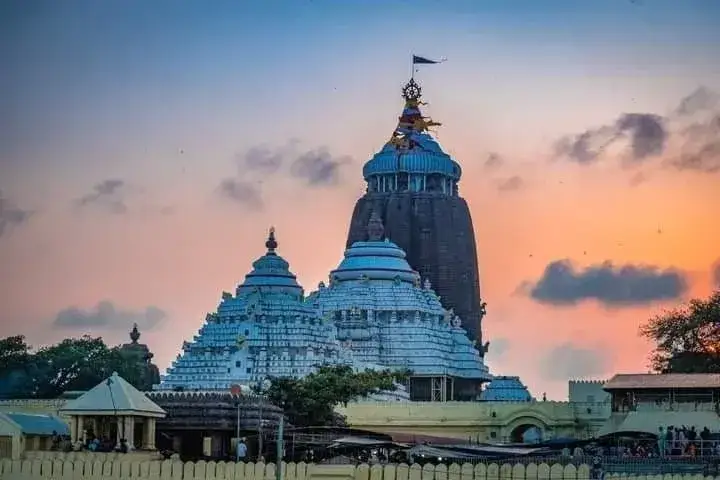
Jagannath Temple in Puri, Odisha, is one of the most sacred Hindu temples in India and a key destination of the Char Dham pilgrimage, famous for the annual Rath Yatra festival.The temple was built in the 12th century. King Anantavarman Chodaganga Deva started the construction. The temple complex is massive. It covers about 4,00,000 square feet. The main tower (shikhara) rises to 214 feet. It is visible from all parts of the city.
The temple is famous for its annual Rath Yatra. During this festival, the deities come out of the temple. They travel to the Gundicha Temple in massive chariots. Millions of devotees gather to pull the chariots.
🛕 Start Your Yatra at Lingaraj Temple First
As per tradition, devotees visit the Lingaraj Temple in Bhubaneswar before going to Jagannath Puri. This is considered the right order for a complete pilgrimage.
About Lingaraj Temple
The Lingaraj Temple is one of the oldest and largest temples in Bhubaneswar. It was built in the 11th century. The temple is dedicated to Lord Shiva in the form of Harihara (a combined form of Shiva and Vishnu). It is a masterpiece of Kalinga architecture.
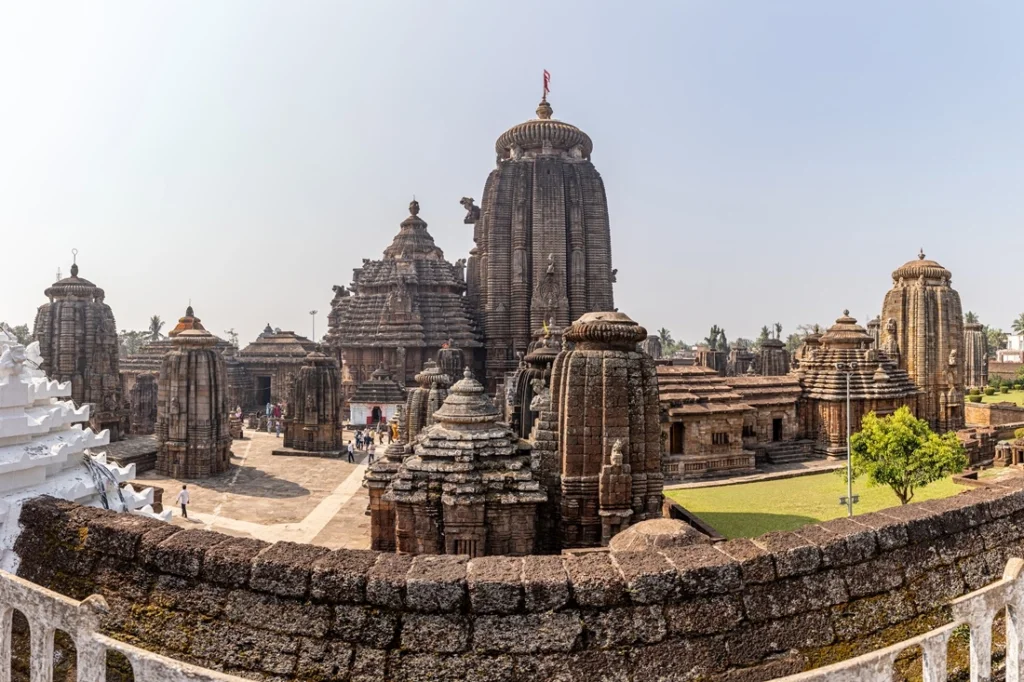
Lingaraj Temple in Bhubaneswar, Odisha, is an 11th-century masterpiece of Kalinga architecture and is traditionally visited first before proceeding to Puri for the Jagannath Yatra.The temple complex is spread over a large area. It has many smaller shrines within its walls. The main tower is 180 feet tall. The temple is surrounded by massive stone walls.
Important: Lingaraj Temple is also open ONLY to Hindus. Non-Hindus can view it from a designated platform outside.
Sample Itinerary: Start with Bhubaneswar
| Day | Activity |
|---|---|
| Day 1 | Arrive in Bhubaneswar. Visit Lingaraj Temple in the morning. Explore Mukteshwar Temple and Udayagiri/Khandagiri Caves in the afternoon. |
| Day 2 | Travel to Puri (60 km, 1.5 hours). Visit Jagannath Temple for darshan. Relax at Puri Beach in the evening. |
| Day 3 | Visit Konark Sun Temple (35 km from Puri). Return to Puri for an overnight stay. |
| Day 4 | Optional: Day trip to Chilika Lake for dolphin watching. Return to Bhubaneswar for departure. |
History of Jagannath Puri Temple
The history of the temple is steeped in legend and devotion.
According to ancient legends, Lord Jagannath was first worshipped as Neela Madhaba in a forest. King Viswavasu secretly worshipped the deity. King Indradyumna heard about this and sent his priest Vidyapati to find the deity.
Vidyapati managed to locate the hidden cave where Lord Jagannath was worshipped. King Indradyumna then built a magnificent temple on Nilasaila (Blue Mountain). However, Brahma’s prolonged meditation caused the temple to be buried under sand.
A celestial voice instructed King Indradyumna to carve new idols from a floating log on the seashore. He erected the temple and enshrined the wooden images of Lord Jagannath, Balabhadra, and Subhadra with unwavering faith.
Today, the temple stands as a symbol of devotion and spirituality.
Why is Jagannath Puri Temple Famous?
The temple is famous for several reasons:
- Char Dham Pilgrimage: It is one of the four most sacred pilgrimage sites in Hinduism.
- Rath Yatra: The annual chariot festival draws millions of devotees.
- Mysterious Phenomena: The flag that flutters against the wind, the no-shadow dome, and the no-fly zone above the temple.
- Mahaprasad: The temple serves a divine feast to thousands of devotees daily.
- Architecture: The temple is a masterpiece of Kalinga architecture.
- ⚠️ Entry Restriction: Only Hindus are allowed inside.
🚩 The Flag Mystery of Jagannath Temple (Patitapavan Bana)
The flag atop the Jagannath Temple is called the Patitapavan Bana. It is famous for two major marvels:
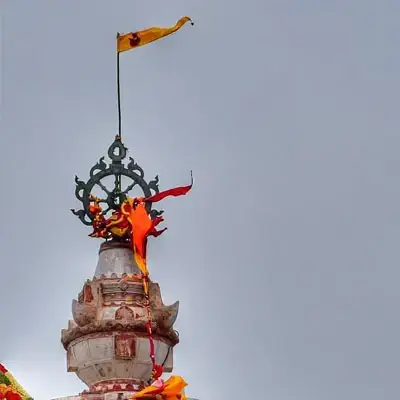
The Patitapavan Bana flag atop Jagannath Puri Temple in Puri is famous for fluttering in the opposite direction of the wind and is changed daily by priests without safety gear.1. The “Against the Wind” Phenomenon
The flag is often seen fluttering in the exact opposite direction of the prevailing breeze. While devotees consider it a divine miracle, scientists have a few explanations:
| Scientific Explanation | How It Works |
|---|---|
| Fluid Dynamics (Kármán Vortex Street) | As the sea breeze hits the tall tower, the wind bifurcates and creates turbulent eddies. This causes a localised reverse wind current at the peak, making the flag flap the other way. |
| Sea and Land Breezes | Puri is a coastal city. The wind blowing off the sea and the breeze returning from the land can move in opposite directions at different altitudes. |
| Architectural Aerodynamics | The temple’s unique structure blocks, splits, and channels wind as it flows upward. This creates circular air currents that alter the localised airflow. |
2. The Daily Flag Ritual
- Every Single Day: Specially trained priests (sevayats) climb the 214-foot dome. They do this without any modern safety gear like ropes or harnesses.
- The Tradition: This ritual is over 1,800 years old. The flag must be changed every day without fail.
- The Belief: According to temple tradition, if the flag is not changed even for a single day, the temple is believed to remain closed for 18 years.
3. Spiritual Meaning
The name Patitapavan Bana translates to “the flag that purifies the fallen.” It is believed to represent salvation for the people and act as a spiritual protector of the land.
Best Time to Visit
| Season | Months | Weather | Recommendation |
|---|---|---|---|
| Winter (Best) | October to February | Pleasant (15-25°C) | Ideal for sightseeing and darshan |
| Summer | March to June | Hot (25-40°C) | Only early morning visits |
| Monsoon | July to September | Rainy | Lush scenery, but beach activities are limited |
| Rath Yatra | June-July | Warm, crowded | Best for festival experience |
Jagannath Puri Temple Timings
The temple is open daily from 4:30 AM to 11:30 PM.
| Time | Activity |
|---|---|
| 4:30 AM – 5:00 AM | Mangala Aarti (Darshan begins) |
| 5:00 AM – 12:00 PM | Darshan continues |
| 12:00 PM – 4:00 PM | The temple closes for rituals |
| 4:00 PM – 10:30 PM | Darshan resumes |
| 10:30 PM | Bedtime rituals |
Tip: The most peaceful time for darshan is early morning (6:00 AM – 8:00 AM) or late evening (9:00 PM – 10:00 PM).
Entry Fee
| Category | Fee |
|---|---|
| Darshan | Free |
| VIP Darshan | ₹50 – ₹100 (varies) |
| Cloakroom (baggage) | Free |
Dress Code
Traditional attire is strictly enforced.
| Gender | Dress Code |
|---|---|
| Men | Dhoti or kurta with pyjama |
| Women | Saree or salwar suit |
Prohibited Items:
- Mobile phones
- Cameras / Smartwatches
- Leather items (belts, wallets)
- Shorts, skirts, ripped jeans, sleeveless tops
Free cloakrooms are available near the main Lion’s Gate (Singhadwara).
Jagannath Puri Rath Yatra (Chariot Festival)
The Rath Yatra is the most famous festival at the Jagannath Temple. It is held annually in June-July. The festival is considered the oldest and largest chariot festival in the world.
Key Events
| Event | Description |
|---|---|
| Main Rath Yatra | The deities travel from Jagannath Temple to Gundicha Temple in massive chariots. |
| Bahuda Yatra | The deities return to Jagannath Temple after staying at Gundicha Temple for 7 days. |
| Suna Besha | The deities are adorned in magnificent gold ornaments. |
The Three Chariots
| Chariot | Deity | Wheels | Height |
|---|---|---|---|
| Nandighosha | Lord Jagannath | 16 wheels | 45 feet |
| Taladhwaja | Balabhadra | 14 wheels | 44 feet |
| Darpadalana | Subhadra | 12 wheels | 43 feet |
The chariots are pulled by devotees along the Bada Danda (Grand Road). Millions of people participate in this auspicious event.
How to Reach Puri
By Air
- Nearest Airport: Biju Patnaik International Airport (BBI), Bhubaneswar
- Distance: ~60 km from Puri
- Travel Time: 1.5 – 2 hours
- Transport Options: Pre-paid taxi (₹1,500 – ₹2,000), AC bus
By Train
- Nearest Railway Station: Puri Railway Station (PURI)
- Direct Trains From: Delhi, Kolkata, Chennai, Mumbai, Howrah
- Special Trains: Indian Railways runs special pilgrim trains during Rath Yatra
By Road
- Highway: NH-316 (well-connected)
- From Bhubaneswar: ~65 km, 1.5 hours
- From Kolkata: ~500 km, 10 hours
- Bus Services: Regular buses from Bhubaneswar and other cities
Google Maps
Jagannath Puri Temple is located in the heart of Puri city.
Nearby Attractions
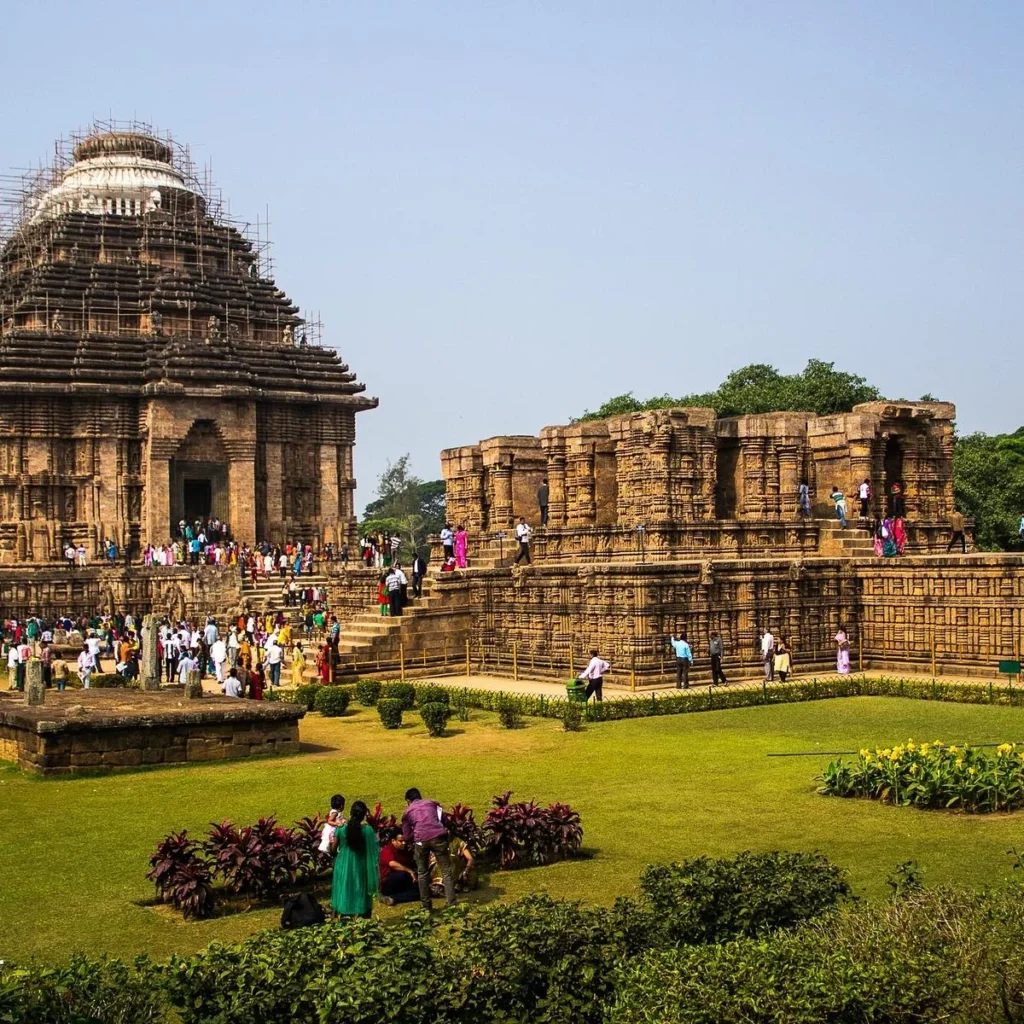
Konark Sun Temple in Odisha is a 13th-century UNESCO World Heritage Site built in the shape of a massive chariot with intricate stone carvings and majestic wheels.| Attraction | Distance | Travel Time | Best For |
|---|---|---|---|
| Lingaraj Temple | 60 km (Bhubaneswar) | 1.5 hours | Ancient Shiva temple, first visit as per tradition |
| Konark Sun Temple | 35 km | 1 hour | UNESCO World Heritage Site, 13th-century chariot-shaped temple |
| Chilika Lake | 50 km | 1.5 hours | Asia’s largest brackish water lagoon, Irrawaddy dolphins |
| Gundicha Temple | 2 km | 10 min | The final destination of the Rath Yatra |
| Puri Beach | 1 km | 5 min | Golden sand beach, sunrise views |
| Raghurajpur Village | 10 km | 20 min | Heritage crafts village, Pattachitra paintings |
| Chandrabhaga Beach | 35 km | 1 hour | Scenic beach near Konark |
🛕 Temple Hopping Itinerary – Must-Visit Temples in Puri
If you have time, visit these important temples around Puri. Here is a suggested route:
| Stop | Temple | Distance | Description |
|---|---|---|---|
| 1 | Jagannath Temple | Starting Point | The main temple, dedicated to Lord Jagannath |
| 2 | Maa Vimala Temple | 3.1 km | A Shakti Peetha temple, located inside the Jagannath Temple complex |
| 3 | Gundicha Temple | 3.8 km | The final destination of the Rath Yatra, called the “Garden House” of Lord Jagannath |
| 4 | Lokanath Temple | 1.4 km | A Shiva temple with a natural spring inside the sanctum |
| 5 | Bedi Hanuman Temple | – | A unique Hanuman temple where the deity is partially buried in the ground |
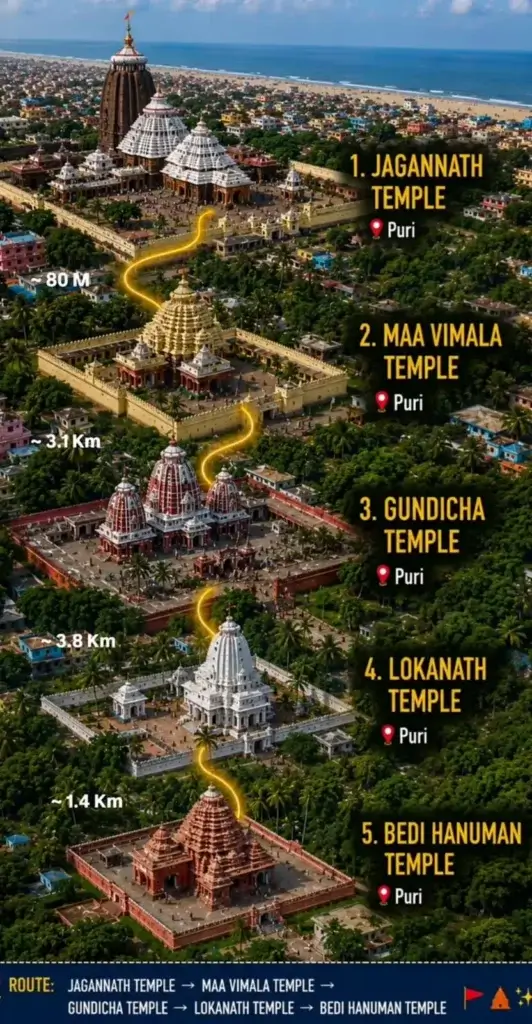
Note: The distances shown are approximate and may vary depending on the route you choose. Always check local directions or Google Maps before travelling.
Things to Do in Jagannath Puri
- Watch the Samudra Arati – Evening prayer ceremony at Puri Beach (7:00 PM)
- Walk on Puri Beach – Golden sands, sunrise views
- Shop for Handicrafts – Pattachitra paintings, seashell crafts, appliqué work
- Visit Raghurajpur Village – Heritage artisans, traditional paintings
- Take a day trip to Chilika Lake – Dolphin watching, birdwatching
- Visit Konark Sun Temple – UNESCO World Heritage Site
- Visit Lingaraj Temple – First stop in Bhubaneswar
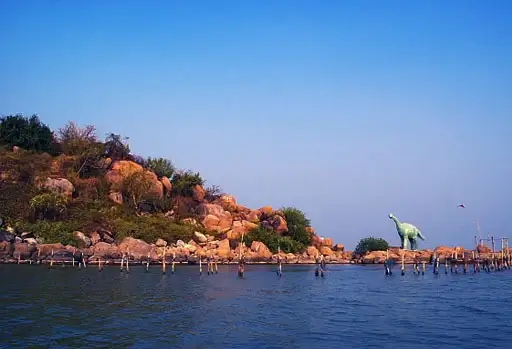
Chilika Lake in Odisha is Asia's largest brackish water lagoon, famous for Irrawaddy dolphins, migratory birds, and scenic boat rides.The Mysteries of Jagannath Puri Temple
The temple is famous for several unexplained phenomena:
| Mystery | Description |
|---|---|
| Flag Against the Wind | The flag atop the temple flutters in the opposite direction of the wind. |
| No Shadow | The main dome casts no shadow on the ground, regardless of the sun’s position. |
| No Fly Zone | No birds or planes fly above the temple. |
| Silence Inside | The sound of ocean waves disappears once you enter the Lion Gate. |
| Mahaprasad Cooking | Food in the topmost pot cooks first, defying standard physics. |
| Nilachakra | The 20-foot wheel atop the temple weighs a tonne. It was installed without machinery. |
Mahaprasad (Sacred Food)
The temple serves a divine feast called Mahaprasad. It consists of 56 food items prepared in 5 phases.
| Type | Description |
|---|---|
| Sukhila | Dry confectionaries |
| Shankhudi | Savoury items like rice, dal, and curries |
The food is cooked in earthen pots over firewood. The cooking method is unique. The pot at the top cooks first. Then the others follow.
Devotees can buy Mahaprasad at Ananda Bazaar inside the temple premises.
Local Food in Puri
| Food Item | Where to Find | Price Range |
|---|---|---|
| Mahaprasad | Ananda Bazaar, Jagannath Temple | ₹50 – ₹200 |
| Khaja | Local sweet shops | ₹100 – ₹300 per kg |
| Chenna Poda | Local sweet shops | ₹150 – ₹400 per kg |
| Dal Vada | Street vendors near the temple | ₹20 – ₹50 |
| Seafood (Prawn, Crab) | Beachside restaurants | ₹300 – ₹800 |
Hotels & Accommodation
Near Jagannath Temple (Walking Distance)
| Hotel | Distance | Price Range |
|---|---|---|
| Hotel Niladri Complex | 200 m from the temple | ₹1,000 – ₹2,500 |
| Hotel Agrawal Pride | 300 m from the temple | ₹2,500 – ₹4,500 |
| Shree Dham Palace | 100 m from the temple | ₹2,000 – ₹4,000 |
Beachfront Resorts
| Hotel | Location | Price Range |
|---|---|---|
| Mayfair Waves Puri | New Marine Drive | ₹10,000+ |
| Sterling Puri | Sipasurubili Beach | ₹4,000 – ₹8,000 |
| Blue Lily Beach Resort | Marine Drive Road | ₹3,000 – ₹6,000 |
Tip: Book at least 2-3 months in advance for Rath Yatra season.
Budget Calculator
| Expense | Budget | Mid-Range | Premium |
|---|---|---|---|
| Hotel (per night) | ₹1,500 | ₹4,000 | ₹10,000 |
| Food (per day) | ₹300 | ₹800 | ₹2,000 |
| Transport (per day) | ₹500 | ₹1,200 | ₹3,000 |
| Entry Fees | ₹50 | ₹200 | ₹500 |
| Total (per day) | ₹2,350 | ₹6,200 | ₹15,500 |
✅ Essential Checklist – Before You Go
| Task | Status |
|---|---|
| 🪪 Carry a government ID (Aadhaar, Voter ID, or Passport) | ⬜ |
| 👕 Wear traditional clothing (dhoti/kurta for men, saree/salwar for women) | ⬜ |
| 💰 Keep cash for donations and offerings | ⬜ |
| 📱 Deposit phones, cameras, and leather items at the free cloakroom | ⬜ |
| 🕒 Reach early during festivals to avoid long queues | ⬜ |
| 🚫 Non-Hindus: View the temple from the designated platform outside | ⬜ |
| 🌊 Follow lifeguard instructions at Puri Beach | ⬜ |
Tip: Complete all preparations before reaching the temple gate. Cloakrooms are available near the Lion’s Gate (Singhadwara).
Travel Tips
- ⚠️ Remember: Only Hindus are allowed inside Jagannath Temple. Non-Hindus cannot enter.
- 🛕 Visit Lingaraj Temple in Bhubaneswar first, as per tradition.
- 🛕 Visit Jagannath Temple early in the morning to avoid long queues.
- 📱 Keep mobile phones, cameras, and leather items in the free cloakroom.
- 👕 Wear traditional attire (dhoti/kurta for men, saree/salwar for women).
- 🚕 Book taxis or tour packages in advance during Rath Yatra season.
- 🌊 Follow lifeguard instructions at Puri Beach. Avoid swimming during high tide.
- 🛍️ Carry cash for local markets and temple donations.
- 🍽️ Try Mahaprasad at Ananda Bazaar.
- 📸 Visit Puri Beach at sunrise for the best photos.
Frequently Asked Questions (FAQs)
Q1: What is the best time to visit Puri?
The best time is from October to February. The weather is pleasant and ideal for sightseeing.
Q2: Can non-Hindus enter Jagannath Temple?
No. Only Hindus are allowed inside the main temple complex. Non-Hindus can view the temple from a designated platform outside.
Q3: Can non-Hindus enter Lingaraj Temple?
No. Lingaraj Temple is also open only to Hindus. Non-Hindus can view it from a platform outside.
Q4: What is the Rath Yatra?
The Rath Yatra is an annual chariot festival. Lord Jagannath, Balabhadra, and Subhadra travel from Jagannath Temple to Gundicha Temple in massive chariots.
Q5: When is the Rath Yatra held?
The Rath Yatra is held in June-July (bright half of Ashadh month).
Q6: What is the dress code for Jagannath Temple?
Men must wear a dhoti or a kurta. Women must wear a saree or a salwar suit. Western wear is not allowed.
Q7: Can I take photos inside the temple?
No. Mobile phones, cameras, and smartwatches are not allowed inside.
Q8: How far is Konark Sun Temple from Puri?
Konark Sun Temple is about 35 km from Puri. It takes about 1 hour by road.
Q9: What is Mahaprasad?
Mahaprasad is the sacred food offered to Lord Jagannath. It consists of 56 food items cooked in earthen pots.
Q10: How can I reach Puri?
Puri is well connected by air (Bhubaneswar airport), rail (Puri Railway Station), and road (NH-316).
Q11: Are there hotels near Jagannath Temple?
Yes. Several hotels and guesthouses are within walking distance of the temple.
Q12: Why should I visit Lingaraj Temple first?
As per tradition, devotees visit Lingaraj Temple in Bhubaneswar before going to Puri.
Q13: What is the flag mystery of Jagannath Temple?
The flag (Patitapavan Bana) flutters in the opposite direction to the wind. It is changed daily by priests climbing without safety gear.
Conclusion
Whether you are a Hindu pilgrim seeking divine blessings or a traveller exploring Odisha’s rich culture, the Jagannath Puri Yatra offers an unforgettable spiritual experience. Start your journey at the Lingaraj Temple in Bhubaneswar, then proceed to Puri for the grand Jagannath Temple darshan. From the majestic Rath Yatra to the peaceful beaches and ancient temples, Odisha has something for everyone. Plan your trip well in advance, follow the temple guidelines, and use our Essential Checklist to ensure a smooth and memorable visit.
⚠️ Important Reminder: The Puri Jagannath Temple is open ONLY to Hindus. Non-Hindus cannot enter the temple premises.
Looking for more travel guides? Stay tuned for our upcoming guides on Tirupati, Kedarnath, Ayodhya, and more.
You May Also Like
- Post Office Types in India – What is HO, SO, BO?
- History of Indian Postal Code System
- Bangalore Emergency Guide
Follow Locatify
Get the latest travel guides, location insights and area highlights from across India.
Discover more places with Locatify.
External Resources
- Shree Jagannath Temple Official Website
- Odisha Tourism Official Website
- IRCTC Tourism – Puri Packages
Disclaimer
Information is from official and publicly available sources. Temple timings, entry rules, and festival dates may change. Please verify before visiting. Non-Hindus are not permitted inside the main Jagannath Temple and Lingaraj Temple.
Last Updated: July 2026
Verified By: Locatify Editorial Team
© 2026 Locatify.in – India’s Location Guide. All rights reserved.