First, have you heard of Indian postal code history? It spans 2,000+ years. It started in 321 BCE. Finally, the modern PIN code arrived in 1972.
So, this guide explains Indian postal code history. To begin, look at ancient times. Then, the Mughal era. After that, British rule. Lastly, the 1972 PIN code.
Now, You can also search any PIN code on our website to see live postal data.
This guide explains Indian postal code history. First, look at ancient times. Next, the Mughal era. Then, British rule. Finally, the 1972 PIN code.
You can also search any PIN code on our website to see live postal data.
Ancient Period in Indian Postal Code History (321 BCE)
How Indian Postal Code History Began
First, Indian postal code history starts in 321 BCE. Specifically, it began with Chandragupta Maurya. Also, his empire used runners and horses. For example, they carried royal messages far.
In addition, relay stations had fresh horses ready. Notably, the Arthashastra book describes this system. Therefore, it had strict delivery rules. Thus, this was the true beginning.
Key Features of Ancient System
| Feature | Detail |
|---|---|
| Start year | 321 BCE |
| Method | Runners and horses |
| Speed | 100 km per day |
| Users | Only royalty |
For instance, Emperor Ashoka used this system. His messages reached all of India.
Mughal Period in Indian Postal Code History (1526-1857)
How Mughals Shaped Indian Postal Code History
Next, Indian postal code history grew under Mughal rulers. For instance, Emperor Sher Shah Suri built the Grand Trunk Road. The road stretched 2,500 km. Moreover, it had postal stations every 2-3 km.
Specifically, these stations were called “dak chowkis.” Furthermore, they kept horses ready 24/7. As a result, a message from Delhi to Agra took 6 hours. Thus, the Mughal system was very fast.
Key Features of Mughal System
| Feature | Detail |
|---|---|
| Road length | 2,500 km |
| Stations | 1,000+ dak chowkis |
| Speed | 150 km per day |
| Users | Royalty and merchants |
British Period in Indian Postal Code History (1766-1947)
When Modern Mail Started
Later, Indian postal code history entered a new phase. So, the British started “Company Mail” in 1766. Specifically, Lord Clive began this system.
Then, in 1774, Warren Hastings opened Calcutta GPO. Notably, this was India’s first GPO. After that, Madras GPO opened in 1786. Finally, Bombay GPO opened in 1794.
The Indian Post Office Act of 1837 unified all systems. Later, Sir Henry Frere modernized everything in 1854. He introduced cheap stamps. For example, a stamp cost just 1/2 anna.
For the first time, common people could mail letters. Thus, this changed Indian postal code history forever.
Key Features of British System
| Feature | Detail |
|---|---|
| Start year | 1766 |
| First GPO | Calcutta (1774) |
| First stamp | 1854 |
| Post offices by 1900 | 10,000+ |
Additionally, Railway Mail Service started in 1854. Consequently, trains made delivery fast. As a result, delivery dropped from weeks to days.
For more official information, visit the India Post official website
Why India Needed a Postal Code (1947-1972)
Problems That Shaped Indian Postal Code History
After independence in 1947, India grew fast. Specifically, the postal system became overwhelmed. For example, there were 23,000 post offices by 1960.
However, sending a letter took 2-3 weeks. Also, manual sorting caused many errors. Therefore, India needed a modern solution.
So, the government appointed a committee in 1961. Specifically, Shriram Bhikaji Velankar led the team. Finally, after 11 years, the PIN code was ready.
The Birth of PIN Code in Indian Postal Code History (1972)
When PIN Code Was Launched
On August 15, 1972, India got its PIN code. PIN stands for Postal Index Number. Specifically, Prime Minister Indira Gandhi launched this system.
Notably, India became one of the first Asian countries with a postal code. Thus, this was a proud moment.
For more official information, visit the India Post official website.
Why 6 Digits?
The 6-digit system was designed by Velankar. Specifically, each digit has a meaning:
| Digit | What It Means |
|---|---|
| 1st | Postal zone (1 to 9) |
| 2nd | Sub-zone or circle |
| 3rd | Sorting district |
| 4th-6th | Specific post office |
For example, PIN 110001 breaks down as:
- 1 = Northern zone
- 1 = Delhi circle
- 0 = Central district
- 001 = Connaught Place PO
Thus, 110001 was India’s first PIN code.
The 9 Postal Zones
Here are the 9 zones created in 1972:
| Digit | Zone | States |
|---|---|---|
| 1 | North | Delhi, Haryana, Punjab |
| 2 | North | UP, Uttarakhand |
| 3 | West | Rajasthan, Gujarat |
| 4 | West | Maharashtra, Goa |
| 5 | South | Karnataka, Andhra |
| 6 | South | Tamil Nadu, Kerala |
| 7 | East | West Bengal, Assam |
| 8 | East | Bihar, Jharkhand |
| 9 | Army | Army Postal Service |
So, the first digit tells you the region. Therefore, this made sorting 90% faster.
Impact of PIN Code on Indian Postal Code History
How PIN Code Changed Everything
The PIN code transformed Indian postal services. Here is the comparison:
| Before 1972 | After 1972 |
|---|---|
| 2-3 weeks delivery | 3-7 days |
| Many errors | 90% fewer errors |
| 23,000 offices | 155,000+ today |
Additionally, PIN code enabled new services. Speed Post came in 1986. Express Parcel came in 1995. Online tracking came in 2010.
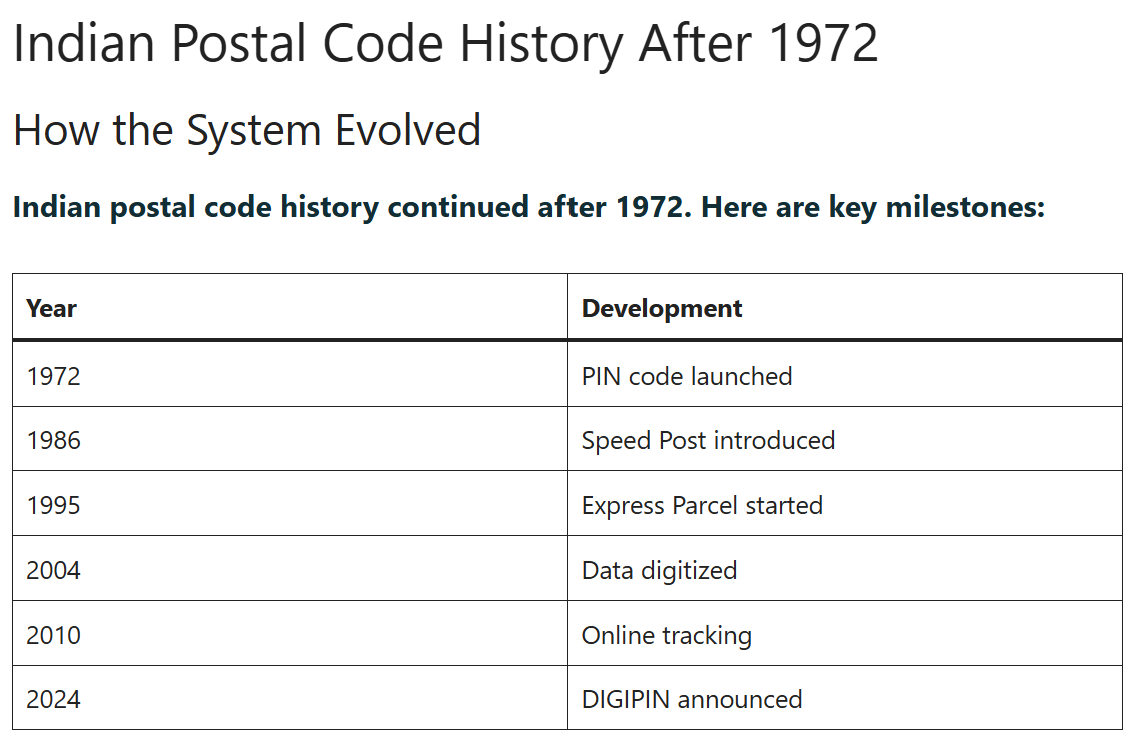
Indian Postal Code History After 1972
How the System Evolved
Indian postal code history continued after 1972. Here are key milestones:
| Year | Development |
|---|---|
| 1972 | PIN code launched |
| 1986 | Speed Post introduced |
| 1995 | Express Parcel started |
| 2004 | Data digitized |
| 2010 | Online tracking |
| 2024 | DIGIPIN announced |
Now, over 155,000 post offices use PIN codes. Consequently, India processes billions of letters yearly.
Fun Facts About Indian Postal Code History
Here are interesting facts:
| Fact | Detail |
|---|---|
| Oldest post office | Kolkata GPO (1868) |
| Largest post office | Mumbai GPO |
| Highest post office | Hikkim (14,400 ft) |
| Floating post office | Dal Lake, Srinagar |
| Active PIN codes | ~19,000 |
| Total post offices | 155,000+ |
For instance, Hikkim is the world’s highest post office.
Why Indian Postal Code History Matters
Understanding Indian postal code history helps you in 3 ways:
First, you see how mail evolved. It took 2,000 years. This journey is amazing.
Second, you know what each PIN digit means. So you can guess a city from its code.
Third, you understand why organized systems help. They connect villages to cities.
Frequently Asked Questions
Q1: Who invented India’s PIN code?
Shriram Bhikaji Velankar designed the PIN code. He was a government official. The system launched in 1972.
Q2: What does PIN stand for?
PIN means Postal Index Number. It is a 6-digit code. India has used it since 1972.
Q3: When did PIN code start in India?
PIN code started on August 15, 1972. Prime Minister Indira Gandhi launched it.
Q4: What was India’s first PIN code?
110001 was the first PIN code. It serves Connaught Place in Delhi.
Q5: How many PIN codes exist today?
India has about 19,000 active PIN codes. They cover 155,000+ post offices.
Learn more about post office types in India.
Summary of Indian Postal Code History
To summarize Indian postal code history:
- 321 BCE: Maurya runners started mail
- 1526 CE: Mughals built dak chowkis
- 1766 CE: British started Company Mail
- 1854 CE: First postage stamp
- 1972 CE: 6-digit PIN code launched
Today, India has the world’s largest postal network. It serves over 155,000 post offices.
Try Our PIN Code Search
Now try our PIN code search tool to find any post office. You will see complete postal details. Indian postal code history comes alive through our data.
| Pincode | Location | Significance |
|---|---|---|
| 110001 | Connaught Place, Delhi | India’s first PIN code |
| 400001 | Mumbai GPO | Historic post office |
| 700001 | Kolkata GPO | Built in 1868 |
External Resources
Learn more from these sources:
- India Post Official Website – Government postal information
- PIN Code History on Wikipedia – Detailed historical background
Source: India Post, Government of India
Published: May 2026
4 thoughts on “Indian Postal Code History: Complete Timeline”